
Overview
The Cartier Tonneau is one of the most distinctive and historically important designs in Cartier’s wristwatch catalogue. Introduced in 1906, the Tonneau was among the earliest wristwatches created for men and arrived just two years after the development of the Cartier Santos, a model widely associated with the emergence of the modern men’s wristwatch. Its curved, barrel-shaped case established a design language that remains unmistakably Cartier more than a century later.
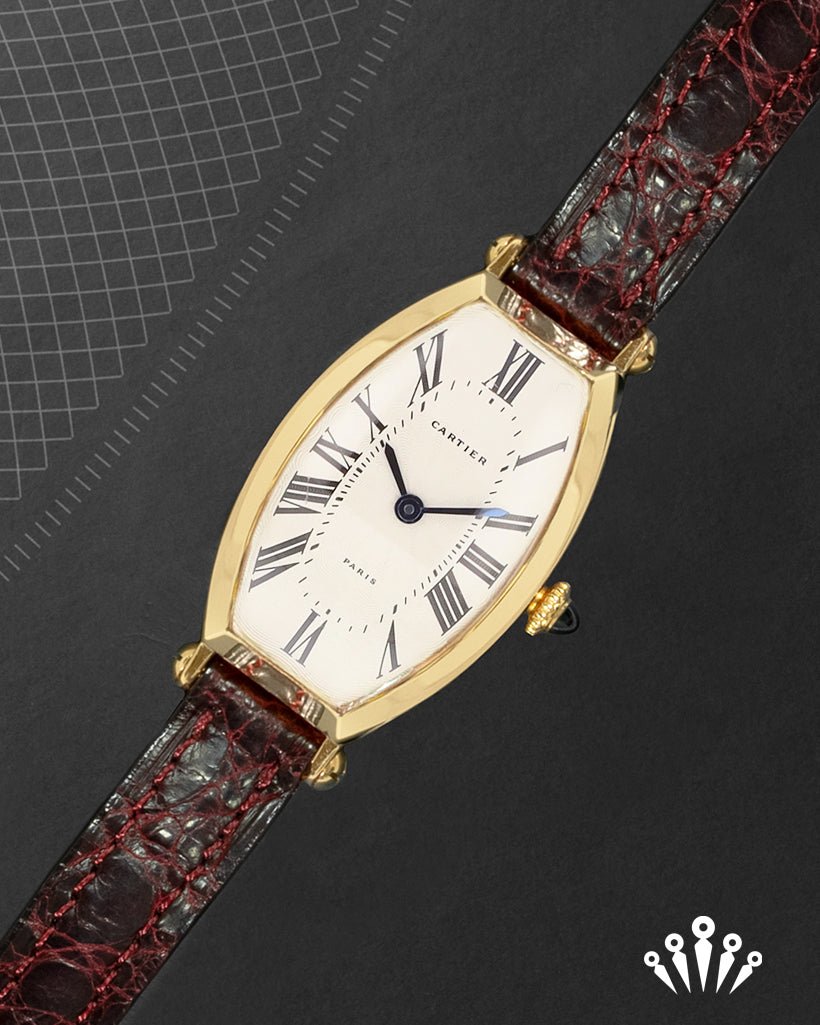
This example is presented in 18ct rose gold and measures 46.1mm by 26.2mm. Its elongated, curved profile is paired with a rich red oxblood leather strap and a matching rose gold clasp, creating a dress watch with considerable presence without relying on conventional round-watch proportions. Priced at £8,995, it offers a compelling opportunity to acquire a historically significant Cartier form with a strong visual identity and enduring collector appeal.
For buyers exploring the wider maison, our selection of Cartier watches includes designs that demonstrate the brand’s ability to combine jewellery-making refinement with practical wristwatch construction. The Tonneau occupies a particularly important place within that story, representing Cartier’s early willingness to challenge established case shapes.
Brand and reference history
Cartier’s reputation in watchmaking is inseparable from its approach to design. Rather than treating the case as a simple container for the movement, the maison has historically regarded the watch as an object of proportion, line and visual character. The Tonneau is an early and important expression of that philosophy. Its curved sides and expanded central body were a deliberate departure from the conventional pocket-watch-inspired forms of the period.
The first Cartier Tonneau appeared in 1906, placing it near the beginning of the wristwatch’s development as a serious form of men’s personal timekeeping. This date gives the design unusual historical weight. It predates many of the familiar shapes that later became associated with classic dress watches and shows Cartier experimenting with ergonomics and identity at a formative moment in horology.
Although the model is historically early, the Tonneau has never depended solely on its age for relevance. Its silhouette has been revisited in various forms over the years because the underlying design remains immediately recognisable. The vertical orientation, curved flanks and balanced symmetry create a watch that is elegant but not anonymous. It is a distinctive alternative to the round dress watch and a natural choice for someone who values design history as much as conventional versatility.
This example carries that heritage in a particularly luxurious material. The use of 18ct rose gold brings warmth to the Tonneau’s architectural shape, softening the geometry with a refined, reddish tone. Combined with the oxblood strap, it gives the watch a coherent palette that feels sophisticated, individual and closely aligned with Cartier’s long-standing relationship with colour and precious metal.
Dial, hands and design detail
The dial is framed by the Tonneau’s most defining feature: its curved rectangular case. That relationship between dial and case is central to the watch’s character. Instead of presenting a simple circular opening, the design creates a vertical stage for the time display, drawing the eye along the length of the wrist. The result is a more formal and sculptural appearance than a conventional round watch can provide.
Cartier’s design language is typically strongest when restraint and recognisability work together, and the Tonneau benefits from that balance. Its proportions give the dial a commanding presence, while the case outline provides the decorative interest. This is a watch that can be appreciated from across a room, yet its appeal is found in the precision of its lines and the way the curves are carried through the entire construction.
The hands form an important part of the visual reading of the watch. Against the dial, they provide the essential contrast required for clear timekeeping while retaining the elegant, pared-back quality expected from a high-end Cartier dress watch. The overall impression is formal rather than sporty, making this a natural companion for tailoring, evening wear and occasions where understated luxury is more appropriate than overt technical display.
Rose gold also changes the way the dial is perceived. Its warm reflection can appear softly polished in one light and more pronounced in another, giving the watch a subtle sense of movement even when it is resting on the wrist. The oxblood strap reinforces this effect, introducing a deeper red tone that complements the case without competing with it.
Case, bracelet and wearability
The case is crafted in 18ct rose gold and measures 46.1mm in length by 26.2mm in width. Those dimensions should be understood in the context of the Tonneau’s shape. The watch is long and relatively narrow, with a vertical orientation that spreads its presence along the wrist rather than across it. As a result, it does not wear like a 46mm round sports watch; its visual impact is more refined, elongated and deliberately dress-led.
The curved profile is one of the watch’s practical strengths. By following the natural shape of the wrist, the Tonneau can sit closely and comfortably when properly fitted, while its articulated-looking outline helps prevent the case from appearing flat or cumbersome. The design is also visually slim in character, even where its measured length gives it a strong presence.
A red oxblood leather strap completes the watch. This is a particularly effective pairing for rose gold because the strap’s dark, saturated tone adds depth while maintaining a warm overall palette. Leather is also the appropriate choice for the model’s formal personality: it keeps the watch light, supple and elegant, and avoids introducing the visual weight that a metal bracelet would bring.
The rose gold clasp provides a considered finishing touch and keeps the precious-metal theme consistent from case to strap. A clasp can also offer a more secure and polished fastening than a traditional pin buckle, particularly on a dress watch where the presentation of the underside matters as much as the dial-side appearance. Together, the case, strap and clasp form a complete design rather than a collection of separate components.
Movement and technical specification
The supplied details confirm the watch’s case material, dimensions and strap configuration, but do not specify the calibre, winding system, power reserve or movement reference. We will not infer those details. Any prospective purchaser requiring precise movement information should contact us before purchase so that the available documentation and inspection findings can be discussed accurately.
That distinction is important with a historically significant dress watch. Cartier Tonneau examples may differ according to period, production series and movement specification, and the technical details can materially affect servicing requirements and collector interest. A responsible description should therefore separate confirmed information from characteristics that require verification.
What can be stated with confidence is that this is a compact, dress-oriented Cartier wristwatch housed in an 18ct rose gold case measuring 46.1mm by 26.2mm. Its configuration is focused on elegance and proportion rather than high-impact sports functionality. The case shape is the principal technical and aesthetic statement, and it reflects Cartier’s early contribution to the development of purpose-designed men’s wristwatches.
For day-to-day ownership, servicing should be undertaken by a suitably qualified watchmaker familiar with Cartier cases and movements of the relevant period. Water resistance should not be assumed for a vintage or historically styled dress watch unless it has been specifically tested and confirmed. Avoiding moisture, shocks and unnecessary magnetic exposure is sensible practice, while routine winding or setting should always be carried out gently.
Sizing and how it wears
At 46.1mm by 26.2mm, the Tonneau has a deliberately elongated footprint. The most important dimension is not the overall length alone but the way that length is distributed. Its narrow width gives the watch a graceful vertical presence, making it appear architectural and elegant rather than oversized in the conventional sense.
On the wrist, the case is likely to appeal particularly to wearers who enjoy distinctive proportions. It will sit naturally on many wrists when the strap is correctly adjusted, although buyers should consider their preferred fit and wrist circumference before committing. The curved construction helps it follow the wrist, while the leather strap allows a degree of flexibility that would be harder to achieve with a rigid bracelet.
The watch is best suited to dress and smart-casual settings. It can bring character to a suit without becoming ostentatious and can also work with more relaxed tailoring where its unusual silhouette becomes the focal point. It is less about universal anonymity and more about personal style: the Tonneau is chosen because it looks like a Cartier Tonneau.
Compared with a conventional round dress watch, this design offers more visual individuality at a similar level of formality. Those considering the broader category can explore our selection of dress & classic watches to compare different approaches to proportion, precious metal and everyday wearability.
Collectability and market value
The Tonneau’s collectability begins with its history. Introduced in 1906, it belongs to the formative period of the men’s wristwatch and demonstrates Cartier’s early confidence in creating shapes specifically for the wrist. That historical position gives the model significance beyond its appearance, particularly for collectors interested in the origins of modern watch design.
Its shape is another important factor. Round watches dominate the broader market, whereas the Tonneau has a clearly defined identity that is immediately associated with Cartier. Distinctive case architecture can be valuable in collecting because it remains recognisable even when viewed without a conventional sports-watch complication or a large catalogue of technical features.
The use of 18ct rose gold adds further appeal. Precious-metal cases bring a sense of permanence and occasion, while the rose tone is especially well suited to the red oxblood strap. This combination is less common than the standard pairing of yellow gold and brown leather, giving the watch a more individual visual presence.
Market value is influenced by many factors, including exact reference, movement, originality, condition, service history, accompanying accessories and the quality of the case. As those details are not all provided here, no unsupported valuation claims should be made beyond the current asking price of £8,995. For a buyer seeking a characterful Cartier with genuine historical relevance, the watch’s appeal lies in the combination of documented design heritage, precious metal construction and distinctive proportions.
Collectors who wish to examine the specific listing in more detail can view this Cartier Tonneau page as part of their consideration. As with any significant pre-owned watch, the most sensible purchase decision combines appreciation of the design with careful review of the condition and available supporting information.
Authenticity, condition and servicing
Authenticity is central to the purchase of any precious-metal Cartier. We present this watch as a Cartier Tonneau in 18ct rose gold, with a red oxblood leather strap and rose gold clasp. Buyers should review the supplied photographs and available details carefully, and we welcome reasonable questions about the case, dial, movement, clasp and supporting documentation before purchase.
The notes provided do not include a detailed condition report, service date, warranty status or provenance, so none of those details should be assumed. The visible condition of a vintage or pre-owned watch can include signs of age and use, and those marks should be considered in the context of the model. On a precious-metal dress watch, small surface changes can form part of its ownership history, while excessive polishing or replacement components may be more significant to a collector.
Strap condition deserves particular attention. Leather is a consumable material and can change with wear, perspiration and storage. The oxblood strap is an important part of this watch’s presentation, but a purchaser should assess its flexibility, stitching and underside before wearing it regularly. If replacement becomes necessary in the future, a carefully chosen strap can preserve the intended balance between the rose-gold case and the deep red tone.
Servicing should be approached conservatively and by a specialist familiar with Cartier watches. A service may involve cleaning, lubrication, regulation and the replacement of worn parts where appropriate, but originality should be respected wherever possible. Before authorising work, owners should ask for a clear estimate and an explanation of any proposed polishing, dial work or component replacement.
Buying this watch from us
At £8,995, this Cartier Tonneau is an opportunity to acquire a rare and historically resonant Cartier design in 18ct rose gold. Its appeal is immediate: the curved case, vertical proportions, oxblood leather strap and matching rose gold clasp create a watch that feels considered from every angle. It is not a generic dress watch, but a recognisable piece of Cartier design history.
We encourage prospective buyers to consider how the Tonneau fits into their existing collection and wardrobe. It is especially well suited to someone who values unusual case shapes, precious metals and the heritage of early wristwatch design. Its formal character makes it a natural choice for evenings and tailoring, while its individuality ensures that it can become a signature piece rather than an occasional accessory.
Before purchase, please ensure that the dimensions and available technical information meet your requirements. We are happy to answer questions about the watch and to clarify the details we can verify. Because the supplied information does not include a movement reference, service history, guarantee or provenance, these should not be presumed and should be discussed directly if they are important to your decision.
A Cartier Tonneau is ultimately bought for more than its specification. It represents a moment when Cartier helped define what a men’s wristwatch could look like, replacing convention with a confident, curved silhouette. This rose-gold example offers that heritage in a luxurious and highly wearable form, with the depth of colour and refined proportions to distinguish it in a serious dress-watch collection.
Frequently asked questions
What material is the Cartier Tonneau case made from?
The case is made from 18ct rose gold. Its warm tone complements the deep red oxblood leather strap and gives the watch a refined, formal appearance.
What are the dimensions of the watch?
The case measures 46.1mm by 26.2mm. Because the Tonneau is elongated and relatively narrow, it wears differently from a 46mm round watch and presents its size vertically along the wrist.
When was the Cartier Tonneau first developed?
The first Cartier Tonneau was developed in 1906. This places it among the earliest wristwatches created for men and gives the design an important position in Cartier’s watchmaking history.
What strap is fitted to this example?
This watch is fitted with a red oxblood leather strap and a rose gold clasp. The dark, saturated colour works particularly well with the warmth of the 18ct rose gold case.
Is the movement specification confirmed?
The supplied information does not specify the movement calibre, winding system or power reserve. Please contact us if you require precise movement details before purchase, so the available information can be checked accurately.
Is the Cartier Tonneau suitable for everyday wear?
It can be worn regularly with appropriate care, but its dress-watch construction means that moisture, shocks and unnecessary exposure should be avoided. The leather strap and precious-metal case are best treated thoughtfully, with servicing handled by a qualified specialist when required.


Reviews
There are no reviews yet.